


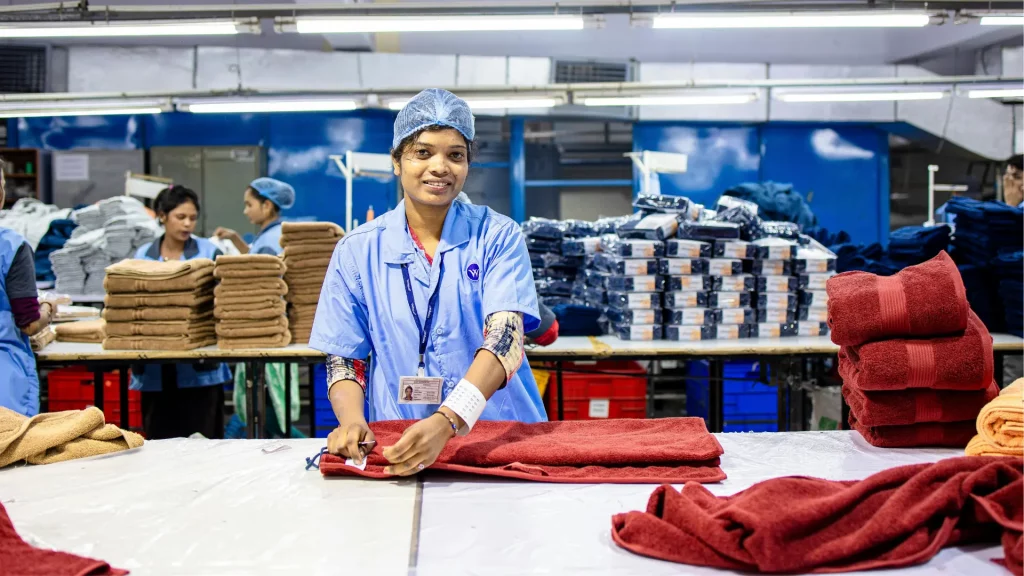

Capacitating the Garment Industry Workers for a Greener Transition in Bangladesh: Just Transition, Capacity, Policy, and Worker Empowerment
Capacitating the Garment Industry Workers for a Greener Climate Transition in Bangladesh is a 3-year project (2024–2027) led by the International Centre for Climate Change and Development (ICCCAD) with support from the Laudes FoundationCapacitating the Garment Industry Workers for a Greener Transition in Bangladesh: Just Transition, Capacity, Policy, and Worker Empowerment.
The initiative adopts a holistic, localized, multistakeholder approach to equip RMG workers and management with climate adaptation knowledge, reinforce worker rights, and support just transition through inclusive dialogue and training.
Four-Axis Transformation through Inclusive Capacity Building and Policy Engagement
To catalyze a greener and fairer RMG sector, the project operates through four interlinked pillars:
1. Capacity Building / Technical Assistance – Co-develops a participatory climate-change training module with garment workers (targeting 300–400 participants), leveraging their lived experiences with heat stress and extreme weather. Pre- and post-training evaluations will assess impact and learning.
2. Data – Generates knowledge products, focus group discussions, and evidence-based reports to capture sector-specific risks, adaptive strategies, and just-transition opportunities.
3. Policy – Facilitates social dialogue among garment workers, factory management, trade unions, civil society, and policymakers to drive policy reforms that integrate climate adaptation, labour rights, and workplace resilience.
4. Worker Rights & Voice – Enhances workers’ agency by involving them as co-creators of solutions, building their capacity to participate in decision-making platforms, and advocating for improved working conditions, such as heat stress mitigation and inclusive governance.
Strategic Outcomes & Theory of Change (2024–2027)
By March 2027:
1. Climate experts will integrate garment workers’ demands into climate policy.
2. Policymakers will encourage factory owners to address climatic risks affecting workers’ health and livelihoods.
3. Government institutions will support mechanisms that amplify workers’ voices in climate-related decisions.
4. Factories will implement improvements in working conditions—such as indoor temperature regulation and rest policy adjustments—driven by worker advocacy.
5. Workforce awareness around rights and adaptation strategies will increase.
6. Project team capability will strengthen, enabling them to scale knowledge sharing, policy safeguarding, and strategic communications