


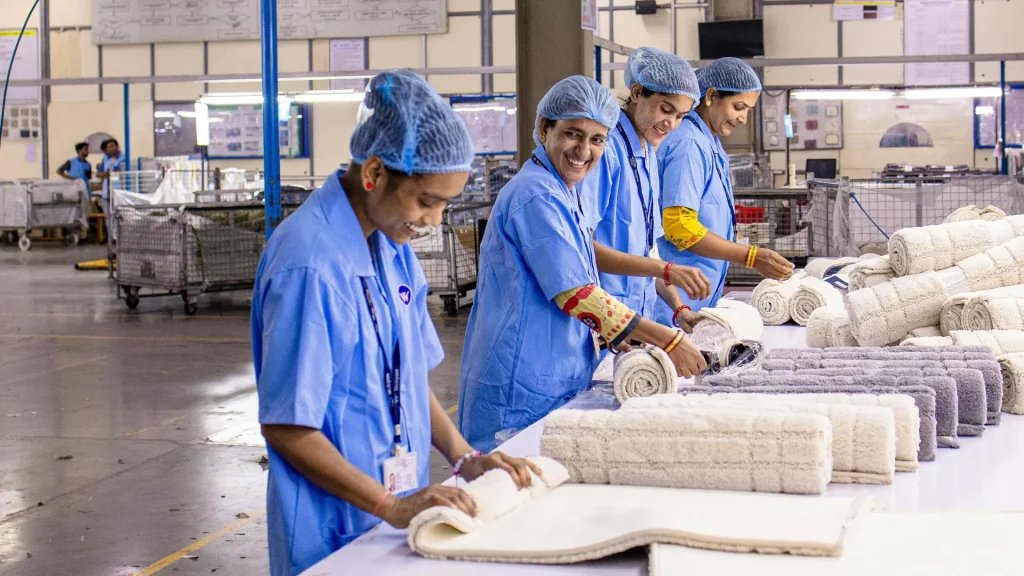

Women Thrive in Bangladesh Activity
This five-year project aims to expand professional development opportunities for over 100,000 women working in Bangladesh’s ready-made garment sector by equipping them with market-oriented leadership skills. It seeks to strengthen women’s advocacy and negotiation capacities both in the workplace and within their communities, helping them overcome gender-related barriers and the impacts of the COVID-19 pandemic.
Five-Axis Transformation via Women Thrive
Data
Baseline studies reveal very few women currently hold leadership roles; many report willingness to take on higher roles. Data is collected on employment, promotion rates, gender disparity, and informal sector participation to track progress.
Capacity Building / Technical Assistance
The programme delivers leadership and life-skills training (including negotiation, communication, financial literacy), trains workplace committees, and equips women to engage in decision-making. It also supports community level awareness and strengthens local women’s groups.
Technology / Machinery
While not a focus on physical machinery, training centres and partner factories are engaged in using training tools and digital/print resources; workplace management practices and systems are encouraged to adapt to support women’s participation.
Finance
The initiative offers training that enhances women’s prospects for promotion or higher-paid work; entrepreneurship modules are offered; it helps improve access to livelihood opportunities and financial literacy, which indirectly improves income earning capacity.
Policy
Engages with factory management to improve policies around gender equality, safe workplaces, negotiation of women’s rights, advocating for better benefits, and reducing gender-based discrimination. Also works with industry associations to encourage institutional adoption of more equitable practices.
Strategic Impact & Value Proposition
Empowered Women Workers
Women gain confidence, leadership skills, and ability to voice their concerns or negotiate for their rights and advancement.
Reduced Gender Barriers
The project addresses social norms, workplace culture, and systemic obstacles (e.g. harassment, unequal opportunity) that limit women’s career growth.
Better Employment Outcomes
Trained women are more likely to secure promotions, better roles, or more stable employment, improving their economic security.
Workplace Environment Improvement
Factories participating in the project are encouraged to develop more gender-sensitive policies and safer, more supportive environments.
Community & Systemic Change
By extending beyond individual factories into communities and involving multiple stakeholders, the programme contributes to longer-term shifts in gender norms, institutional practices, and economic inclusion.