


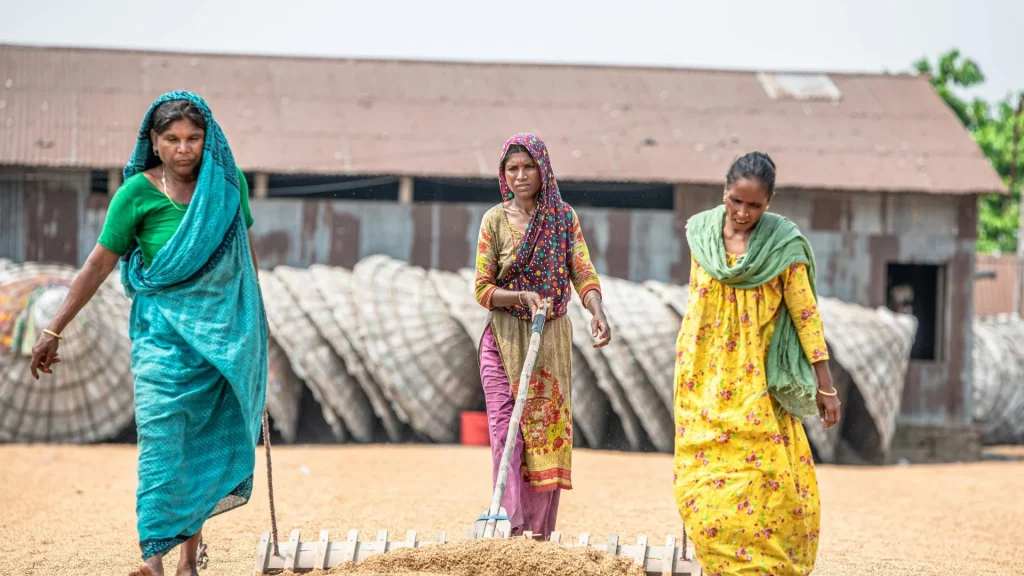

CREA: Community-based Resilience, Women’s Empowerment and Action
CREA aims to build women’s leadership capacity and increase the resilience of the most vulnerable communities to the impacts of climate change. It works with women and girls in marginalised, climate-vulnerable areas, addressing both environmental challenges and intersecting issues such as child marriage, domestic violence, governance, livelihood insecurity, and access to basic services. The project supports collectivised action, awareness raising, adaptation planning at the local level, diversified livelihood options, and improved access to water, sanitation, and health services.
Five-Axis Transformation via CREA
Data: Baseline surveys, participatory assessments and monitoring are used to map vulnerabilities, social inequalities, service delivery gaps, and behavioural patterns (e.g. around gender‐based violence, child marriage) to inform planning and evaluation.
Capacity Building / Technical Assistance: Training is provided to women and girls for leadership, collective action, climate change awareness, and adaptation planning. Local institutions and service providers are supported to become responsive to women’s needs and climate vulnerabilities.
Technology / Machinery: Initiatives include promoting climate-resilient agriculture (on-farm/off-farm), livestock rearing adapted to changing conditions, and supporting water access improvements. These sometimes involve introducing improved tools or technologies for resilient farming and water management.
Finance: The project helps women access small-loan funds for income-generating activities, enabling livelihood diversification and financial resilience. It supports community level funds and alternative livelihood options.
Policy: CREA engages with local government and public institutions to ensure that adaptation planning, service provision (water, sanitation, health), and institutional responsiveness integrate women’s and gender issues. It also advocates for addressing governance, social justice, and reducing prevalence of child marriage and domestic violence in climate-vulnerable areas.
Strategic Impact & Value Proposition
Strengthened Community Resilience: By empowering women and girls, and fostering collective local action, the project improves resilience of marginalised communities to climate shocks (flooding, cyclones, changing rainfall, etc.).
Gender Equality & Social Justice: CREA works to reduce harmful social practices (child marriage, domestic violence), improve access to basic services, and support women’s leadership and voice in community decisions.
Improved Livelihoods & Income Security: Diversified livelihood options—climate-resilient agriculture, livestock, off-farm work—lead to increased income, reduced poverty risks, and more sustainable economic security for families in climate-vulnerable zones.
Enhanced Service Delivery & Institutional Responsiveness: Public services (water, sanitation, reproductive health) and local government institutions become more responsive to the needs of marginalised women and climate-vulnerable populations.
Scalability & Local Ownership: Using locally led approaches, community funds, and collective action, the project builds ownership at ground level, which enhances sustainability and replication potential across vulnerable areas.