


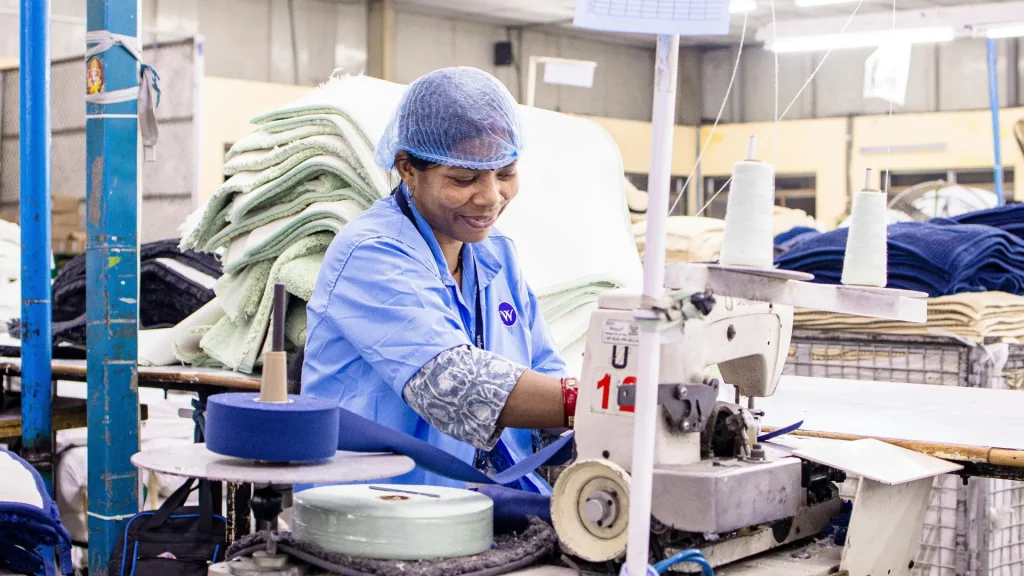

SOSI: Strengthening Social Insurance & Introducing Employment Injury Insurance in Bangladesh’s Textile & Leather Sector
SOSI is a development project in Bangladesh aimed at fortifying the country’s social insurance system, with particular emphasis on introducing Employment Injury Insurance (EII). The goal is to ensure long-term protection for workers against accidents at work and occupational diseases, especially in the textile and leather industries. It works in collaboration with government ministries, industry stakeholders, and international partners to build institutional capacity, craft legal and administrative frameworks, and enhance access to social protection.
Five-Axis Transformation via SOSI
Data:The project establishes and maintains a workers’ database covering the textile and leather sectors to underpin the design and monitoring of insurance schemes. It collects data on workplace accidents, injury and disease incidence, commuting accidents, compensation claims, and gaps in existing legal provisions. This data is used to assess coverage levels, monitor scheme operations, and guide reforms.
Capacity Building / Technical Assistance: SOSI supports the Ministry of Labour and Employment and other relevant government agencies to set up administrative processes for a pilot Employment Injury Scheme. It provides assistance in establishing occupational medicine services and supports training for officials, industry actors, employers, and workers on prevention, rehabilitation, and compensation. Technical advice is also given to help develop grievance mechanisms and improve institutional readiness.
Technology / Machinery: While physical machinery is less central, the project invests in digital tools and systems for managing social insurance: digital registry of workers, tools for processing claims, systems to track and monitor service delivery, and platforms to support transparency and good governance. These enable efficient administration and better access for eligible workers.
Finance: Funded by international development partners, SOSI helps secure financial commitment from the government for the pilot scheme and its eventual scaling into a permanent, employer-financed Employment Injury Insurance programme. The project also supports financial modelling to ensure sustainability, cost-sharing arrangements, and budgetary allocations for compensation, health, rehabilitation, and system maintenance.
Policy: The initiative works with legislative and regulatory bodies to develop legal frameworks for Employment Injury Insurance that align with international labour standards. It engages in policy dialogue to codify employer responsibilities for accident prevention, establish rules for compensation, and integrate insurance protections into national labour law. It also encourages policy coherence across ministries and promotes tripartite consultation among government, employers, and worker representatives.
Strategic Impact & Value Proposition
Better Protection for Workers: Workers in the textile and leather sectors gain access to formal protection in cases of work-related injuries, death, or occupational illness. This reduces the vulnerability of workers and their families to loss of income and health care burdens.
Improved Institutional Capacity and Governance: The Ministry and associated agencies gain stronger capacity to administer insurance schemes, collect and manage data, enforce regulations, and uphold rights. Digital systems and credible administrative processes provide more reliable, transparent services.
Enhanced Industry Reputation & Competitiveness: Employers in these sectors benefit from improved occupational safety, reduced risk of litigation or reputational loss, and better alignment with international procurement standards. The adoption of injury protection can support competitiveness in markets that value worker welfare and compliance.
Systemic Legal and Policy Change: The legal codification of Employment Injury Insurance, the development of rules for prevention, rehabilitation, and compensation, and engagement with stakeholders help ensure that protection becomes embedded in national labour law and policy rather than being an ad-hoc or pilot measure.
Sustainable Social Protection Expansion: The pilot Employment Injury Insurance scheme is designed to be scalable and sustainable, with clear pathways toward inclusion of more sectors beyond textiles and leather. Over time, the project helps move Bangladesh toward more inclusive, durable social protection systems for workers.